Three HACCP zone-boundary failures that dry steam at 180°C solves
Most food-plant sanitation audits flag the same structural gaps — here is what they are and how superheated steam addresses them without stopping the line.
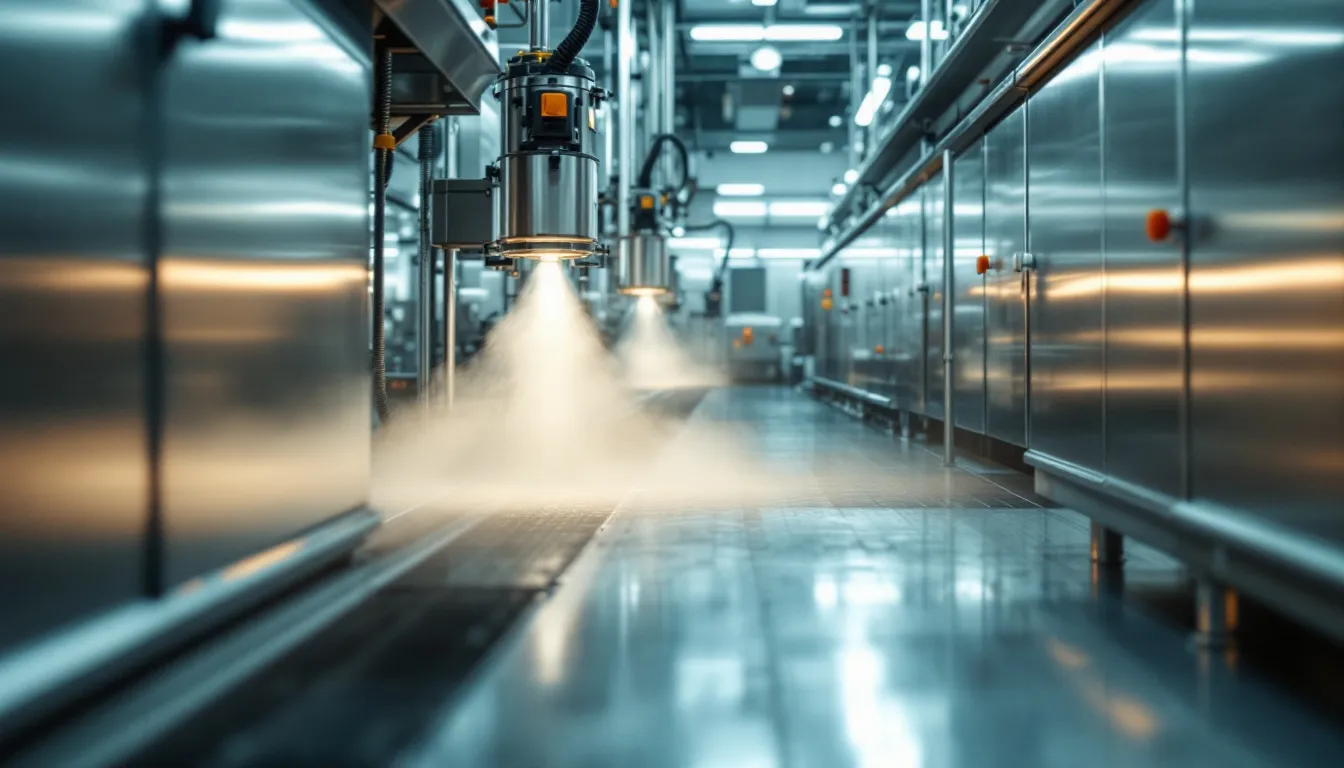
A food-plant sanitation audit should be a confirmation, not a discovery session. Yet the same three zone-boundary failures appear on non-conformance reports from Gdańsk to Győr to Galați, year after year. They are not failures of effort — they are failures of method, and they tend to cluster at exactly the points where HACCP zone boundaries meet equipment that was never designed with cleanability as a primary requirement.
The three failures auditors keep writing up
1. Condensate and chemical residue at zone transition points. HACCP zone boundaries — typically the line between a high-care zone (Zone 1 or 2) and a lower-risk area — are defined by physical barriers, airlocks, or at minimum, clear procedural separation. The problem is that conventional high-pressure wet cleaning generates aerosol and pooling water that travels. A pressure washer running at 80–150 bar produces droplets fine enough to carry Listeria monocytogenes across a nominally sealed boundary. Beyond the microbiological risk, chemical sanitizers applied at zone edges leave residue on conveyor frames, drain lips, and undercarriage surfaces that standard rinse cycles do not fully remove. In a dairy or RTE meat facility operating under EC 852/2004 hygiene regulation, a single swab failure at a zone boundary can trigger a partial line shutdown and a corrective action report that follows the site for three audit cycles.
2. Inaccessible geometry on zone-boundary equipment. Conveyor belt undercarriages, frame welds, roller bearings, and the undersides of transfer plates are the structural features that sit exactly where zone boundaries are drawn — and they are the features least accessible to manual cleaning or pressure-wash nozzles. Surface roughness on a welded frame joint can reach Ra 6–12 µm in practice; Listeria biofilm establishes reliably above Ra 0.8 µm on stainless steel. Auditors checking EN 1672-2 food-zone equipment standards will flag any surface that cannot be demonstrated to reach the required hygiene level. The geometry problem is not solvable with more chemical or more pressure — it requires a cleaning medium that penetrates recesses without leaving a liquid residue behind.
3. Line-stop time that accumulates into a compliance gap. The third failure is systemic rather than physical. When sanitation requires full line stoppage, cool-down, chemical application, dwell time, rinse, and dry-out before restart, the realistic cleaning window shrinks. Production pressure shortens dwell times. Abbreviated dwell times mean sanitizers do not reach the bacterial reduction level set out in the plant’s HACCP critical control point documentation. When an auditor pulls time-stamped cleaning records and cross-references them against production logs, abbreviated cycles are visible. This is not a people problem — it is a method problem that creates a documented compliance gap.
Why superheated dry steam changes the arithmetic on all three
Dry steam at 180°C — the operating range of equipment in the Fortador Pro Max class — is not wet steam and it is not pressurized water. The vapor exits at low pressure (typically 8–9 bar at the boiler, dropping to 4–6 bar at the nozzle) but at a temperature well above the water boiling point. The result is a cleaning medium with less than 5% moisture content by mass at the point of contact. That distinction matters for three specific reasons.
First, there is no aerosol migration. Low-pressure dry steam does not generate the fine droplet cloud that a high-pressure washer produces. You can operate a Fortador Pro Max unit at a zone boundary without contaminating the adjacent area — a meaningful advantage when the alternative is erecting temporary physical barriers and adding 40 minutes to the cleaning protocol.
Second, the thermal energy penetrates geometry that nozzles cannot reach. Steam flows around roller bearings, into frame weld recesses, and under conveyor transfer plates. What can be stated precisely is the physics: the steam temperature follows from the boiler pressure, at the nozzle it is close to the boiler value, and ten centimetres away it is still at least 100 °C. We do not publish a percentage reduction — a figure such as 99.9% only means something when it is tied to a named organism, a temperature and a contact time, measured under a validated protocol. What we do instead is measure the result on the spot with an ATP test, where the Kikkoman release value is under 200 RLU. The steam then evaporates, leaving the surface dry. No rinse cycle. No chemical residue to swab-test.
Third, the line-stop window compresses significantly. A zone-boundary cleaning run that previously required 90 minutes of wet chemistry — application, dwell, rinse, dry — can be completed with a dry-steam pass in 20–35 minutes depending on linear meter count and equipment density. That is not a marketing claim; it is a function of eliminating the rinse and dry-out phases entirely. For a facility running two production shifts, recovering 50–60 minutes per sanitation cycle per week translates directly into scheduled production time.
Get a tailored demo at your site →
What the compliance record looks like after the switch
The documentation argument for dry steam is as practical as the operational one. A HACCP plan requires evidence that critical control points are being addressed at the specified frequency and to the specified standard. When the cleaning method is dry steam, the evidence chain is shorter and cleaner: temperature log from the steam unit, operator sign-off, ATP swab result. There is no chemical concentration to measure, no dwell-time window to defend, no rinse-water disposal record under local wastewater permit.
For facilities operating under BRC Global Standard for Food Safety Issue 9 or IFS Food Version 8, both of which require documented cleaning validation for zone-boundary equipment, a validated dry-steam protocol with thermal log output is a defensible record. It also satisfies the REACH-adjacent concern that some EU retail customers now raise in supplier audits — specifically, the question of whether cleaning chemistry residues are present in the production environment at detectable levels.
The practical starting point is a zone-boundary audit of your own site before the external auditor does it. Identify the three or four pieces of equipment that sit at zone transitions, check the surface finish and accessibility of their undercarriage geometry, and pull the last six months of cleaning records to verify dwell times were actually met. If any of those checks produces a finding, the fix is a method change, not a procedure change. Dry steam at 180°C is one method that addresses all three of the failure modes described above — without adding chemistry, without adding water, and without stopping the line.