Degrease food-industry equipment — no chemicals, no rinsing
At 20 bar, steam leaves the nozzle at approx. 215 °C and dissolves burnt grease from equipment, hoods and belts in seconds — without aggressive detergents and without the rinsing step that stops the line.
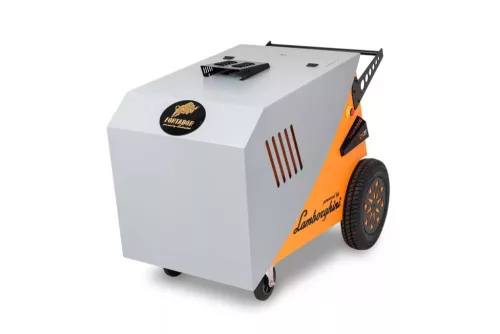 Fortador Pro Max 20 Bar
Chemical degreasers require dwell time, scrubbing and rinsing — and the residue must be removed completely before the line can restart.
In the food industry, burnt grease on hoods, griddles, belts and equipment is not just a hygiene problem but a time problem. Chemical degreasers require dwell time, scrubbing and, above all, a complete rinse before the line can restart — because no residue is allowed to reach the surfaces that touch food.
Dry steam shortens this chain. The heat dissolves the grease, the pressure lifts it off, and the absence of detergents means there is no longer a rinsing step. The surface stays clean and almost dry, ready to restart.
What temperature the steam actually reaches on your equipment
In degreasing, temperature is the parameter that does the work — and this is exactly where many manufacturers’ datasheets mislead. The truth is simple: steam temperature is not chosen, it follows from pressure. The relationship is fixed and is read off the Mollier diagram: at 4 bar steam is 152 °C, at 10 bar 185 °C, at 16 bar approx. 205 °C, and at 20 bar 215 °C. A 4-bar machine cannot put out 200 °C, whatever the brochure promises — and a temperature quoted without the corresponding pressure is a figure with nothing behind it.
The machine recommended below works at 20 bar, so it produces steam at approx. 215 °C — well above the 185 °C threshold at which steam becomes superheated, with humidity under 5%. For polymerised grease that counts twice over: the heat softens it, and the small amount of water means you are not washing the grease into a puddle you then have to mop up.
Pressure and temperature are at their maximum at the nozzle outlet and fall away with distance. In the first few centimetres, steam is practically at boiler temperature; at 10 cm from the surface it still carries at least 100 °C; at 30–40 cm it is harmless even to the operator’s hand. That is why degreasing is done up close — and why the delicate areas around the work zone are unaffected.
Below you will find the mechanism, the relevant parameters, the recommended equipment and what it means for downtime and costs.
Consequences
What classic degreasing costs you
- !A line stopped for dwell time, scrubbing and rinsing
- !Chemical residue to remove from food-contact surfaces
- !Recurring cost of degreasers and hot water
- !Operator exposure to aggressive substances
- !Burnt grease left in hard-to-reach areas
The solution
How dry steam degreases — thermally, without rinsing
The heat of the dry steam softens and dissolves the grease, and the pressure lifts it off the surface. Because it uses very little water and no detergent, no rinse residue remains — the surface is clean and dry, ready to restart.
| Parameter | Value | Role |
|---|---|---|
| Pressure | 20 bar | Lifts the deposits off the surface |
| Temperature at the nozzle | approx. 215 °C | Follows directly from the pressure (Mollier diagram) — softens and dissolves burnt grease |
| Temperature at the surface | over 100 °C at 10 cm | The working distance at which the grease lifts off and the surface is sanitized |
| Detergents | zero / minimal | No rinsing, no residue on food areas |
- Steam temperature follows directly from pressure, per the Mollier diagram: at 20 bar, steam leaves the nozzle at approx. 215 °C.
- Superheated steam at approx. 215 °C dissolves burnt grease and deposits without aggressive detergents.
- No rinsing step — the dead time between cleaning and restarting the line is eliminated.
- No chemical residue on surfaces that touch food.
- It reaches joints, mesh and hard-to-access areas where grease accumulates.
See it for yourself
Industrial degreasing with dry steam, on site
Degresare Industrială cu Abur Uscat • Generator de Abur Uscat Menikini Steam Master • HD CleanersCommentary in Romanian.
Who it is for
The same problem, across several industries
Recommended equipment
Recommended equipment: Fortador Pro Max 20 Bar
Fortador Pro Max 20 Bar
High-pressure dry steam for the rapid degreasing of equipment and hoods in the food industry — no chemicals, no rinsing.
Price excludes VAT and shipping costs
ROI and risk
Less dead time, without the cost of chemicals
- Eliminate the recurring cost of degreasers
- No rinsing step — the line restarts faster
- Reduce the risk of non-compliance (no chemical residue)
- Risk-free trial: AUTONOM rent-to-buy
Frequently asked questions
What we get asked most
Does dry steam remove burnt grease, not just fresh grease?+
Do I have to rinse after steam degreasing?+
Can I degrease without stopping the line for long?+
Show us what needs cleaning.
We'll help you decide what to test first.
Send us a few details, photos or a short video of the application. Within one business day, a technical sales consultant will review it and come back with the next best step — additional questions, a first recommendation or a proposed test.