Remove mould from your food plant — thermally, without chemicals
At 16 bar, steam leaves the nozzle at approx. 205 °C and destroys mould, spores and bacteria within seconds — in the damp areas where chemicals only postpone the problem, with no residue on food surfaces.
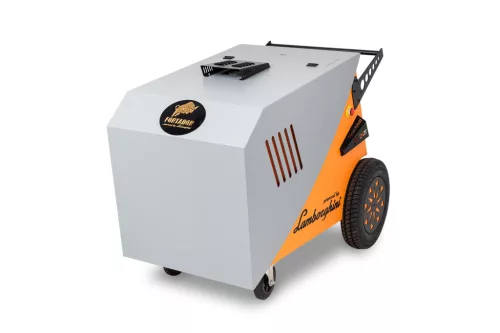 Fortador Pro Max 16 Bar
You clean the mould with biocides, but it returns to the same damp corners within a few weeks — because the moisture and spores remain.
In food plants, mould is not a matter of appearance but of compliance. It appears in damp areas — cold rooms, washing zones, floor joints, ceilings in cooking areas — and it returns exactly where it was cleaned with biocides, because the chemical method treats the surface, not the environment.
Dry steam changes the logic: instead of adding a chemical, it adds heat. It thermally destroys spores and hyphae, and the minimal amount of water means the surface dries almost immediately — without the residual moisture mould needs to regrow.
How much heat actually reaches the mouldy corner
Steam temperature is not something you pick from a catalogue: it follows from pressure, and the relationship is fixed and read off the Mollier diagram. At 4 bar steam is 152 °C, at 10 bar 185 °C, at 16 bar approx. 205 °C. A 4-bar machine cannot put out 200 °C, whatever the datasheet promises — which is why a temperature quoted without the corresponding pressure tells you nothing.
Above 185 °C steam becomes superheated, with humidity under 5%. That is exactly where the advantage against mould lies: plenty of heat, almost no water. Pressure and temperature are at their maximum at the nozzle outlet and fall away with distance — but at 10 cm from the surface steam still carries at least 100 °C, enough to inactivate the spores. At 30–40 cm it is already harmless even to the operator’s hand, which makes the method safe in the tight spaces where mould appears.
Below you can see the mechanism, the parameters your hygiene officer can verify, the recommended equipment and what it means for costs and risk.
Consequences
What you risk if the mould returns
- !Non-compliance at the food-safety audit
- !Product contamination and recall of a batch
- !Odours and degradation of storage areas
- !Recurring cost of biocides that don't fix the cause
- !Repeated shutdowns of the affected area
The solution
How dry steam eliminates mould — at the root
Mould needs moisture. Superheated steam delivers heat (approx. 205 °C at the nozzle) with very little water: it thermally destroys spores and hyphae, and the surface dries almost immediately — the exact opposite of the environment in which mould regrows.
| Parameter | Value | Role |
|---|---|---|
| Pressure | 16 bar | Lifts the deposits and drives the steam into joints and seams |
| Temperature at the nozzle | approx. 205 °C | Follows directly from the pressure (Mollier diagram) — destroys spores and hyphae |
| Temperature at the surface | over 100 °C at 10 cm | The working distance at which mould is thermally inactivated |
| Steam humidity | under 5% | The surface dries quickly, with no residual moisture |
| Chemicals | zero | No biocides, no residue on food zones |
- Steam temperature follows directly from pressure, per the Mollier diagram: at 16 bar, steam leaves the nozzle at approx. 205 °C.
- Above 185 °C and under 5% humidity, steam is superheated — it destroys mould, spores and bacteria within seconds of contact.
- At 10 cm from the surface, steam still carries more than 100 °C — enough to inactivate the spores even in joints and corners.
- Uses minimal water — leaves no stagnant moisture to feed recontamination.
- No biocides, no chemical residue on food-contact surfaces.
- Reaches joints, seams and hard-to-access corners where mould hides.
See it for yourself
Mould on the conveyor belt — removed without chemicals
Mucegai pe bandă transportoare? Soluția profesionistă cu abur uscatCommentary in Romanian.
Who it is for
The same problem, across several industries
Recommended equipment
Recommended equipment: Fortador Pro Max, dry steam
Fortador Pro Max 16 Bar
High-pressure dry steam for the thermal sanitizing of areas with recurring mould — no chemicals, with immediate surface drying.
Price excludes VAT and shipping costs
ROI and risk
Fix the cause, not just the symptom
- Eliminate the recurring cost of biocides
- Fewer repeated shutdowns of the contaminated area
- Surfaces dry immediately — resume production quickly
- Risk-free trial: AUTONOM rent-to-buy
Frequently asked questions
What we get asked most
Does dry steam kill mould or just clean it off the surface?+
Why does mould return after cleaning with chemicals?+
Can I use steam on food-contact surfaces?+
Show us what needs cleaning.
We'll help you decide what to test first.
Send us a few details, photos or a short video of the application. Within one business day, a technical sales consultant will review it and come back with the next best step — additional questions, a first recommendation or a proposed test.