How to pass your HACCP audit with chemical-free sanitizing — using dry steam
At 16 bar, steam leaves the nozzle at approx. 205 °C and, 10 cm from the surface, still carries more than 100 °C — the temperature at which thermal disinfection happens, with no disinfection chemical at all and no residue on food-contact surfaces. Your HACCP plan stays fully documented.
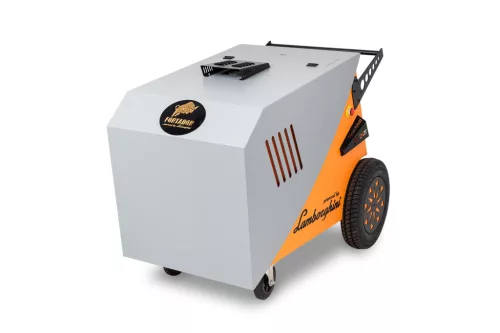 Fortador Pro Max 16 Bar
The chemical method passes the audit today. But residues, rinsing, drying times and bacterial resistance stay on your risk list.
For a food-production manager or a restaurant owner, the real question is not which machine to buy, but how to pass the next audit without trouble. And the current method — chemical detergents and disinfectants — seems to work: it passed the audit last year too.
The problem is that this very method leaves you with a risk list the auditor knows well: chemical residues on food-contact surfaces, a rinsing step that can be done incompletely, drying times that stop the line and, over time, bacterial resistance. Each of these is a point where an otherwise clean audit can wobble.
What HACCP actually requires at the disinfection step
HACCP does not mandate a specific chemical. It requires that the sanitizing of food-contact surfaces be effective, verifiable and documented. The sanitizing step almost always has two components: first cleaning (removing dirt and grease), then disinfection (reducing the microbial load below a safe threshold). Which method you use for disinfection is up to you, as long as the result is demonstrable.
This is where the common misunderstanding arises: chemical-free does not mean you give up on HACCP or documentation. It means you replace the chemical disinfectant with thermal disinfection — the rest of the plan (frequencies, responsibilities, records, checks) stays identical.
Why chemical residues are themselves a risk
In HACCP logic, cleaning and disinfection chemicals are classified as a potential chemical hazard. If the rinsing step is incomplete or skipped under time pressure, residues end up on food-contact surfaces. Add to that operator exposure, the recurring cost of consumables and, in the long run, the selective pressure that favours more resistant bacterial strains.
Thermal disinfection leaves nothing to rinse off: after dry-steam treatment, only a minimal amount of water remains on the surface, and it evaporates quickly. Nothing extra to declare, nothing to rinse, nothing to dry before restarting the line.
How hot the steam actually gets
This is the point where many manufacturers’ datasheets mislead, so it is worth stating plainly: steam temperature is not a catalogue option, it is a consequence of pressure. The relationship is fixed and is read off the Mollier diagram: at 4 bar steam is 152 °C, at 7 bar 170 °C, at 10 bar 185 °C, at 16 bar approx. 205 °C, at 20 bar 215 °C. There is no 4-bar machine that puts out 200 °C, whatever the brochure promises.
What that means for you: if someone quotes you a temperature without telling you the pressure, the figure means nothing. A 16-bar machine, like the one recommended below, produces steam at approx. 205 °C — above the 185 °C threshold at which steam becomes superheated, with humidity under 5%. Below 140 °C steam is wet and leaves water on the surface; between 140 and 185 °C it is dry steam; above 185 °C it is superheated. Both dry and superheated steam disinfect — but the lower the humidity, the drier the surface stays and the sooner it is back in use.
The second question any technician asks: fine, but how much of that reaches my surface, rather than staying in the boiler? Steam is at its maximum pressure and temperature only at the nozzle outlet. From there, both fall away with distance. In the first few centimetres, steam is practically at boiler temperature. At 10 cm from the object it still carries at least 100 °C — enough to destroy bacteria, viruses and mould spores. At 30–40 cm it is already completely harmless, including to the operator’s hand.
That is why working distance is a process parameter, not a detail: sanitizing is done a few centimetres from the surface, and that is where the temperature counts. And the cleaning effect does not come from heat alone — the water, in a nanoparticle state, lifts dirt and grease without any chemical. Because no detergent film is left behind to hold dust, the surface stays clean longer than after a classic wash.
Where the problem appears — zones and industries
The same pain recurs across different industries: a bakery with recurring mould in damp areas, a slaughterhouse where grease and biofilm build up on belts and machines, a bottling line with hard-to-reach spaces, a HoReCa kitchen where the sanitizing window between shifts is just a few dozen minutes. In all of them, the critical surfaces are the same: stainless steel, countertops, hoods and ventilation, cold rooms, joints and seams, packaging equipment.
For each of these zones, the steam parameters (pressure, flow, nozzle type) are adjusted so the technology is effective on hard deposits and, at the same time, safe on delicate components.
How to validate and document the result
Switching to steam does not change how you prove compliance. Validation uses the same accepted tools: ATP/bioluminescence tests or surface (swab) samples before and after sanitizing, compared against the internal threshold. The results are recorded in the same monitoring logs. For the auditor, the change is a single one and easy to explain: the disinfection method has become thermal, the evidence remains.
One point here is worth pressing, because most suppliers walk around it. Normally, “clean” is a judgement call: the surface looks clean, so you move on. An ATP tester takes the judgement out of it. The device detects adenosine triphosphate — the molecule present in every living cell and in any organic residue — and turns biological contamination into a number, expressed in RLU. For smooth, easy-to-clean surfaces in direct food contact, the manufacturer of the Lumitester (Kikkoman) recommends a pass level of no more than 200 RLU — a manufacturer benchmark, not a legal requirement.
The practical consequence is simple: measure the same surface before and after sanitizing and you have two numbers. Not an impression, not a supplier’s promise — two values you can enter in your HACCP records and show to an auditor. At the demonstration on your premises we bring the Lumitester and measure together, before and after cleaning, on your surfaces and with your real soiling — you are left with two measured values, not a promise.
Below you can see the mechanism with the exact parameters a HACCP officer can verify, the recommended equipment and what this change means for costs and risk.
Consequences
What a failed audit costs you
- !Production stoppage until the issue is fixed
- !ANSVSA fines and warnings
- !Recall of a batch from the market
- !Cross-contamination between zones
- !Loss of a retail contract
- !Chemical residues — a chemical hazard within HACCP logic itself
The solution
How dry steam disinfects — thermally, with no chemical residue
Dry steam does not mask the problem with another chemical: it solves it thermally. It replaces disinfection chemicals with heat, removing the rinsing step and detergent residue from food-contact surfaces — while your HACCP documentation (cleaning and monitoring) stays unchanged.
| Parameter | Value | Role |
|---|---|---|
| Steam humidity | under 5% (dry steam) | Avoids water residue that can attract contamination |
| Pressure | 16 bar | Removes grease and deposits without chemicals |
| Temperature at the nozzle | approx. 205 °C | Follows directly from the pressure (Mollier diagram) — superheated steam |
| Temperature at the surface | over 100 °C at 10 cm | The working distance at which bacteria, mould and viruses are destroyed |
| Residues | no chemicals | Reduces contamination risk in food zones |
| Verification | below 200 RLU | Kikkoman's recommended pass level for smooth food-contact surfaces |
- Steam pressure and temperature are physically locked together: at 16 bar, steam leaves the nozzle at approx. 205 °C — not a catalogue figure, but the pressure–temperature relationship read off the Mollier diagram.
- Above 185 °C and under 5% humidity, steam is superheated — the state in which it works through heat, not chemistry.
- At 10 cm from the surface, steam still carries more than 100 °C — the temperature at which bacteria and viruses are destroyed. At 30–40 cm it is already harmless to the hand.
- Thermal disinfection, not chemical — no detergent residue on food-contact surfaces.
- Your HACCP plan stays complete: cleaning and monitoring are documented exactly as before.
- Minimal water, no drying times — surfaces return to production quickly.
- The result is measured objectively with an ATP tester: for smooth, easy-to-clean surfaces in direct food contact, the Lumitester manufacturer (Kikkoman) recommends a pass level of no more than 200 RLU.
- Cleanliness stops being a subjective judgement — it becomes a number, measured before and after, that goes into your HACCP records.
See it for yourself
Dry steam vs alcohol disinfectants — the test, on film
Igienizare în industria alimentară: abur uscat vs dezinfectanți alcoolici | HACCP și IFSCommentary in Romanian.
Who it is for
The same problem, across several industries
Recommended equipment
Recommended equipment: Fortador, industrial dry steam
Fortador Pro Max 16 Bar
Dry steam at 16/20 bar for daily thermal sanitizing in professional kitchens, food lines and HACCP surfaces — no disinfection chemicals, no dead drying times.
Price excludes VAT and shipping costs
ROI and risk
Lower risk, without the recurring cost of chemicals
- Eliminate the recurring monthly cost of detergents and disinfectants
- Fewer steps: no rinsing, no drying, no chemical handling
- Reduced risk of audit non-compliance — documentable disinfection
- The result is verifiable on the spot with the ATP tester: you see it as a number, not as a promise
- Risk-free trial: AUTONOM rent-to-buy, 100% of the rent is deducted from the price
Frequently asked questions
What we get asked most
Can I pass the HACCP audit without disinfection chemicals?+
Does dry steam kill mould and bacteria?+
Does steam leave residue on food surfaces?+
What parameters does effective thermal disinfection require?+
How much does switching from chemicals to steam cost?+
On which surfaces and zones can dry steam be used?+
How do I validate that the thermal disinfection worked?+
What is an ATP test and why does it matter at an audit?+
Does dry steam also replace the cleaning step, or only disinfection?+
In which industries does this method apply?+
Show us what needs cleaning.
We'll help you decide what to test first.
Send us a few details, photos or a short video of the application. Within one business day, a technical sales consultant will review it and come back with the next best step — additional questions, a first recommendation or a proposed test.