Clean injectors and complex parts with ultrasound — no scrubbing, no wear
Ultrasonic cavitation at 28 kHz generates microbubbles that lift deposits from the channels and cavities you cannot reach by hand — it cleans the part on the inside too, without mechanical scrubbing. Frequency, temperature and detergent are matched to the material and the deposit.
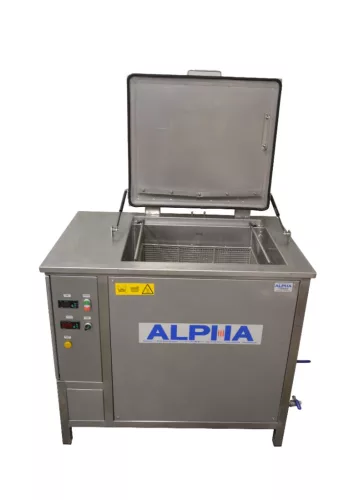 ALPHA AIC
A part with fine channels never gets fully clean with a brush or by hand — the deposit stays exactly where you cannot reach, and wear or scrap returns with every cycle.
For a workshop manager or a quality officer, the pain is the same regardless of industry: a part with complex geometry — an injector, a nozzle, a carburettor, a component with fine channels — never gets fully clean with a brush or by hand. The deposit stays exactly where you cannot reach, and the problem (wear, scrap, failures) returns with every cycle.
And classic methods not only fail to reach the inside — they create new problems. Brushes and abrasives wear the threads and fine surfaces. Aggressive solvents expose the operator. And however carefully one works, the result depends on the person and the day, so it varies.
Why scrubbing does not solve precision parts
A precision part has precisely those zones that matter most — internal channels, orifices, threads, cavities — that no brush ever touches. Manual cleaning treats the outer surface and misses the inside. The result: residual deposit, incorrect injector flow, assembly failures and scrap discovered too late.
What ultrasonic cleaning changes
Ultrasound shifts the problem from how do I scrub better to how do I clean without touching the part. In a bath of solution, high-frequency waves generate millions of microbubbles that implode on the surface of the part — the phenomenon of cavitation. These implosions lift the contaminant from every zone wetted by the solution, including the channels and cavities that scrubbing cannot reach.
For the decision-maker, that means consistent results and less scrap. For the operator, it means placing the parts in a basket, starting the cycle and receiving clean parts — without part-by-part labour. For the process engineer, it means a parameter that can be set and repeated: frequency, power, bath temperature, time.
Why it does not wear the part
This is the natural technical question. The answer lies in the mechanism: the energy of the cavitation acts on the layer of contaminant, not on the metal. There is no mechanical contact, scrubbing or abrasion. That is why the method is the standard precisely where parts are expensive and delicate — fine mechanics, aerospace, medical instruments.
Below you will find the exact parameters, the recommended equipment and what the switch to ultrasound means for scrap, labour and wear. And the clearest proof remains a practical one: we bring one of your parts and clean it in front of you.
Consequences
What manual cleaning of precision parts costs you
- !Internal channels and cavities that stay dirty no matter how much you scrub
- !Wear on the part and on the threads from brushes, scrapers and abrasives
- !Long labour time for each part, one by one
- !Inconsistent results — depending on the operator and the day
- !Scrap and failures from remaining deposits (injectors, nozzles, carburettors)
- !Exposure to aggressive solvents and their vapours
The solution
How ultrasound cleans — through cavitation, not scrubbing
In a bath of solution, the ultrasonic transducers generate high-frequency waves. These create millions of microbubbles that implode on the surface of the part (cavitation) and lift off the contaminant — including from channels, threads and cavities no brush can reach. The energy acts on the deposit, not on the metal, so the part does not wear.
| Parameter | Value | Role |
|---|---|---|
| Ultrasonic frequency | 28 kHz (40 kHz optional) | Cavitation that cleans micro-channels without abrasion |
| Ultrasonic power | 750–4000 W (depending on model) | Energy for stubborn deposits |
| Heating power | 2000–8000 W | Activates the solution without attacking the part |
| Tank capacity | 60–240 litres | From individual parts to serial batches |
| Chamber | AISI 316L stainless steel | Resists aggressive solutions, durable over time |
| Mode of action | cavitation, no mechanical contact | Zero wear on delicate parts |
- Cavitation at 28 kHz lifts deposits from channels and cavities you cannot reach by hand, without mechanical scrubbing.
- The energy acts on the contaminant, not on the substrate — fine parts are cleaned on the inside too, without wear.
- The ultrasonic chamber is made of AISI 316L stainless steel, resistant to aggressive solutions; the housing is AISI 304.
- Heating the bath (2000–8000 W, depending on the model) activates the solution to dissolve oils and deposits, without attacking the metal.
- Tanks from 60 to 240 litres — from individual parts to entire batches, with consistent results.
See it for yourself
Cavitation at work — the part cleaned in seconds
Curățare cu ultrasunete în câteva secunde | Cum funcționează cavitațiaCommentary in Romanian.
Who it is for
The same problem, across several industries
ROI and risk
Consistent results, no wear, no part-by-part labour
- Batch cleaning instead of manual part-by-part labour — at your volume, that means hours recovered
- Consistent results, independent of operator and day — less scrap and fewer failures
- No brushes and abrasives — eliminate wear on threads and fine surfaces
- Less operator exposure to solvents and to manual scrubbing
- Risk-free trial: we bring one of your parts and clean it during the demonstration
Frequently asked questions
What we get asked most
Does ultrasonic cleaning ruin fine parts or threads?+
How does it clean injectors on the inside, where a brush cannot reach?+
What types of dirt does it remove?+
Can I clean several parts at once?+
How much does the equipment cost?+
In which fields is it used?+
Show us what needs cleaning.
We'll help you decide what to test first.
Send us a few details, photos or a short video of the application. Within one business day, a technical sales consultant will review it and come back with the next best step — additional questions, a first recommendation or a proposed test.