Clean the injection mould on the machine, with less disassembly and without water
For the cavity of a mould, the method we put first is dry ice: it cleans directly on the machine, without water and without anything to rinse off. The laser stays an option — but our TIPORA range is continuous-wave fibre, and the heat a continuous laser puts into a fine cavity is a risk we discuss beforehand, not afterwards.
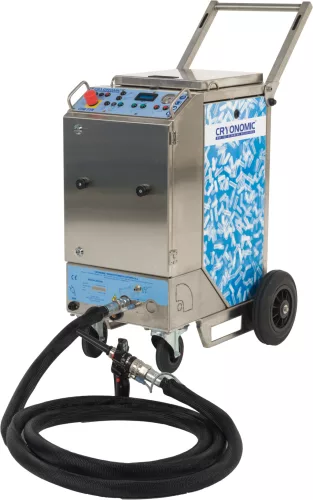 CRYONOMIC COB 71
The mould is not idle because it is dirty. It is idle because the cleaning method requires disassembly, transport and reassembly — and every hour the station is stopped is paid for in lost production.
For a maintenance manager or a production head in an injection department, the real question is not which cleaning machine do I buy, but how do I stop the line less every time the mould needs cleaning. And the usual method seems logical: stop, remove the mould, clean it with brushes, abrasives or solvents, reassemble it, restart.
The problem is that this very cycle — disassembly, transport, reassembly — consumes most of the time. The dirt itself does not keep the machine idle; the cleaning method does. On top of that comes the risk that wire brushes and abrasives scratch the cavity and ruin its fine texture — the very surface on which the quality of the moulded part depends.
Where time and money are actually lost
An injection mould is an expensive, precise tool. Every classic cleaning means: hours of downtime for disassembly and reassembly, the risk of scratching from abrasive methods, consumables (abrasives, solvents), and in the case of wet cleaning, the risk of corrosion. And if the deposits (burnt resin, oxides, release agents) remain partly, moulding defects appear — marks, burns, release problems — which are paid for in scrap.
What contactless cleaning changes
The method shifts the problem from how do I clean better by scrubbing to how do I stop disassembling at all. Cleaning is done in situ, directly on the injection machine. Which contactless method fits, however, depends on the mould: for a cavity, the heat input of a continuous-wave laser — and our TIPORA range is continuous-wave — is a risk we do not pass over in silence. For moulds we put dry ice first, with or without the abrasive module.
In concrete terms, that means three things a decision-maker feels directly: the disassembly and reassembly time disappears, the mechanical friction of wire brushes and abrasive media on the cavity disappears, and the recurring consumables disappear. For the operator, it means cleaner work, without physical effort and without chemicals.
Continuous wave or pulsed — the difference that decides
This is the technical question every maintenance manager asks, and rightly so. The honest answer is not “the laser damages nothing”, it is: it depends on the type of laser.
A continuous-wave laser delivers energy without interruption. On rust on thick plate that is exactly what you want. On a mould cavity, where microns of texture matter, continuous heat input can heat and damage the surface. Our TIPORA range is continuous wave — 1000, 1500, 2000 W — and that is precisely why we do not offer it as the default method for moulds.
A pulsed laser works in short bursts: the energy goes in and stops again before the substrate heats up. That is the right class for moulds. We are preparing the technical documentation on this together with our partners; until it is ready we would rather say what we know than promise what we cannot stand behind.
Dry ice — the method we put first for moulds
For mould cleaning, in plastics injection as much as in the automotive industry, the method we recommend is dry ice blasting.
CO₂ pellets at −78.5 °C hit the deposit, make it brittle by thermal shock and lift it off — then sublimate, passing straight into gas. No water is left behind, no blasting media to sweep up, no residue in cooling channels or vents. Dry ice is softer than the mould steel: the action is thermal and kinetic, not abrasive.
For burnt resin and hard layers, CRYONOMIC machines can run an abrasive module — with glass beads, for example. And here it has to be said plainly: in that configuration the process becomes abrasive, and it does not suit every surface. What gets used on your mould is decided on your mould, not from a table.
What it means in practice:
- cleaning without disassembly, on the injection machine itself, where access allows
- no water and no solvents — so no corrosion risk and no drying before restart
- no media to collect: the pellets disappear, only the loosened deposit remains
- a real consumable: CO₂ pellets (20–80 kg/h depending on machine and setting)
How we decide together
There is only one proof worth having: a demonstration on an old mould of yours. Bring the part, we clean it in front of you, and you see the result before deciding anything. If the right answer for your case is none of our machines, we will tell you that too.
Consequences
What classic mould cleaning costs you
- !Long production stops for disassembling and reassembling the mould
- !Scratches and wear from wire brushes or abrasive methods
- !Loss of the texture and fine finish of the cavity
- !Moulding defects from remaining deposits (burns, marks, release)
- !Recurring costs for abrasives, solvents and consumables
- !Risk of corrosion where wet cleaning is used
The solution
How we clean the cavity — sublimation, not scrubbing
For a mould the question is not laser-or-nothing, but which method lifts the deposit without touching the cavity. Our TIPORA laser range is continuous-wave (CW) fibre, and on a fine cavity the heat input of a continuous laser is a real risk, not a footnote — a pulsed laser is a different instrument, and we do not sell one. That is why, for moulds, the method we put first is dry ice.
| Parameter | Value | Role |
|---|---|---|
| Pellet temperature | −78.5 °C | Sublimates on contact — no water, no residue |
| Pellet consumption | 20–80 kg/h, adjustable and displayed | Set according to the type and thickness of the deposit |
| Blasting pressure | 1–12 bar | Lowered on fine cavities, raised on hard deposits |
| Air consumption | 0.5–6 m³/min at 1–12 bar | Determines the compressor you need |
| Working medium | no water, no solvents | Nothing to rinse off, no corrosion risk |
| Laser (option, with a caveat) | 1000–3000 W, continuous-wave fibre | Only where the heat input is acceptable — discussed beforehand, not afterwards |
- The CO₂ pellet reaches the surface at −78.5 °C and sublimates on contact: it goes straight from solid to gas, lifts the deposit and leaves nothing to rinse off.
- The pellet is softer than the mould steel — unlike a wire brush or abrasive media, it does not grind away the fine texture of the cavity.
- The process is dry: no water and no solvents, therefore no corrosion risk and no drying time before the line restarts.
- With the abrasive module fitted, the process becomes abrasive. We use it only where the deposit demands it, and never on a fine cavity without discussing it with you first.
- Cleaning happens with the mould still mounted on the injection machine — avoiding precisely the step that consumes most of the downtime.
Who it is for
The same problem, across several industries
Recommended equipment
Recommended equipment: CRYONOMIC COB 71
CRYONOMIC COB 71
An industrial machine with a 30 kg hopper, pellet consumption adjustable between 20 and 80 kg/h and a blasting pressure of 1–12 bar — it reaches the mould directly on the injection machine, cleans by sublimation and leaves nothing to rinse off. On fine cavities the pressure is turned down.
ROI and risk
Less downtime, an untouched cavity, no residue
- At your line's cost of standing still, every in-situ cleaning recovers the hours lost to removing and refitting the mould
- No wire brushes and no abrasive media on the cavity — the mechanical friction that ruins the fine texture disappears
- A dry process — nothing to rinse off, no drying time and no corrosion risk before the restart
- The consumable is dry ice, and consumption is set to the deposit, between 20 and 80 kg/h
- A test without risk: we ask for a demonstration on an old mould of yours, before any decision
Frequently asked questions
What we get asked most
Can I clean the mould without removing it from the injection machine?+
Does the laser scratch or damage the mould surface?+
Which contaminants are removed from the mould?+
How fast does it clean?+
Does it use water, solvents or abrasives?+
What does it cost and can it be financed?+
In which industries are moulds cleaned on the machine?+
Show us what needs cleaning.
We'll help you decide what to test first.
Send us a few details, photos or a short video of the application. Within one business day, a technical sales consultant will review it and come back with the next best step — additional questions, a first recommendation or a proposed test.