Cut the time and cost of cleaning in food production — with dry steam
At 20 bar, steam leaves the nozzle at approx. 215 °C: it dissolves grease and sanitizes thermally, with no detergent, no rinsing and no drying time — a single station supplies up to 5 operators at once, so the line returns to production sooner.
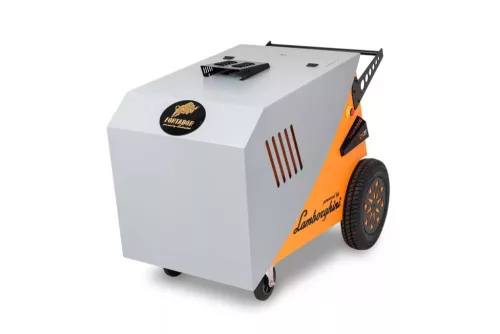 Fortador Pro Max 20 Bar
Cleaning with detergent and water seems cheap — until you add up the labour hours, the rinsing, the drying time the line sits idle and the monthly chemical cost. That is where the real cost hides.
For a production manager or an owner in the food industry, cleaning looks like a fixed, minor cost: detergent, water, a few hours of staff time. That is precisely why it stays unoptimized for years. But the real cost is not on the detergent invoice — it hides in the labour hours, in the rinsing, in the drying time the line sits idle, and in the consumables bought month after month.
And in the end, the result is uneven: grease and biofilm quickly return on belts and machines, and the sanitizing depends on how rushed the operator was that day.
Where the time actually goes
A classic cleaning cycle has several time-consuming steps: scrubbing with detergent, rinsing, then drying before the line can restart. Each step adds minutes, and the drying time adds minutes in which nothing is produced. Multiply that by the number of sessions per month and the team’s hourly cost — that is the sum that matters, not the price of the detergent.
What dry steam changes
Dry steam compresses these steps. It dissolves grease thermally, not through lengthy scrubbing, and sanitizes at the same time. Being dry, it leaves no puddles and needs no drying time: the surface is ready almost immediately.
It is worth explaining why it works, because this is where many datasheets mislead: steam temperature is not chosen from a catalogue, it follows from pressure. The relationship is read off the Mollier diagram and it is fixed — at 4 bar steam is 152 °C, at 10 bar 185 °C, at 16 bar approx. 205 °C, at 20 bar 215 °C. The station recommended below works at 20 bar, so it produces steam at approx. 215 °C, well above the 185 °C threshold at which steam becomes superheated, with humidity under 5%.
Temperature is at its maximum at the nozzle outlet and falls away with distance, but at 10 cm from the surface steam still carries at least 100 °C — the temperature at which bacteria, mould and viruses are destroyed. At 30–40 cm it is already harmless, including to the operator’s hand. In practice: the grease removal and the disinfection happen in the same pass, a few centimetres from the surface.
For the decision-maker, this means fewer labour hours and less downtime. For the operator, it means less scrubbing and less chemical handling. A single Fortador Pro Max station supplies up to 5 operators at once, so an entire hall is covered within the same window between shifts.
How much you save — on your figures, not on promises
We won’t give you an invented figure of the “from 2 hours to 15 minutes” kind. The real saving depends on your staff hourly cost, the number of sessions per month and how much time you now lose on rinsing and drying. That is why we propose a demonstration at your premises: we measure the current time of a session, compare it with steam and calculate the saving together on your own figures.
Below you can see the exact parameters of the station, the recommended equipment and what this change means for downtime and operating cost.
Consequences
Where the cost of classic cleaning hides
- !Labour hours for scrubbing, rinsing and drying, session after session
- !Drying time during which the line sits idle between shifts
- !Recurring monthly cost of detergents and disinfectants
- !Lots of water and wastewater to manage
- !Grease and biofilm that quickly return on belts and machines
- !Uneven results, dependent on the operator and the rush
The solution
How dry steam shortens the cleaning cycle
At 20 bar, steam leaves the nozzle at approx. 215 °C and dissolves grease and deposits thermally, not through lengthy scrubbing. Being superheated (under 5% humidity), it leaves no puddles and needs no drying time — and even 10 cm from the surface it still carries more than 100 °C, the temperature at which bacteria, mould and pathogens are destroyed. Fewer steps, less time, and the line returns sooner.
| Parameter | Value | Role |
|---|---|---|
| Pressure | 20 bar | Lifts the deposits and determines the steam temperature |
| Temperature at the nozzle | approx. 215 °C | Follows directly from the pressure (Mollier diagram) — dissolves grease |
| Temperature at the surface | over 100 °C at 10 cm | The working distance at which thermal disinfection is achieved |
| Steam type | superheated, under 5% humidity | No puddles, no drying time — the line restarts quickly |
| Operators at once | up to 5 | More surface sanitized within the same time window |
| Diesel consumption | 0.6 litres/hour | Low operating cost for an industrial station |
| Boiler capacity | 11.5 litres | Autonomy for long cleaning sessions |
| Power supply | electric-diesel hybrid | Works even where you don't have enough electrical power |
- Steam temperature follows directly from pressure, per the Mollier diagram: at 20 bar, steam leaves the nozzle at approx. 215 °C.
- Superheated steam dissolves grease and sanitizes in the same step — 10 cm from the surface it still carries more than 100 °C, the temperature at which pathogens are destroyed thermally.
- Being dry steam, with low humidity, it leaves no puddles and needs no drying time — the line returns to production quickly.
- A single station supplies up to 5 operators at once, so you cover more surface within the same window between shifts.
- Consumption is 0.6 litres of diesel per hour and little water — low operating cost, with no recurring detergents at the thermal disinfection step.
- Fewer steps: grease dissolving and thermal disinfection happen in the same step, with no subsequent rinsing.
Who it is for
The same problem, across several industries
Recommended equipment
Recommended equipment: Fortador Pro Max 20 Bar
Fortador Pro Max 20 Bar
The most powerful dry-steam station in the range — 20 bar, which means steam at approx. 215 °C, electric-diesel hybrid, supplies up to 5 operators at once. For the fast daily sanitizing of halls and food lines.
Price excludes VAT and shipping costs
ROI and risk
Less downtime, lower operating cost
- At your staff hourly cost and the number of sessions per month, shortening the cleaning cycle translates directly into labour hours saved — we calculate them together on your figures
- No rinsing and no drying time — the line returns to production sooner after each sanitizing
- Low operating cost: 0.6 l of diesel per hour and little water, with no recurring chemical consumables at thermal disinfection
- Up to 5 operators from a single station — cover a larger hall within the same window between shifts
- Risk-free trial: AUTONOM rent-to-buy, 100% of the rent is deducted from the price
Frequently asked questions
What we get asked most
How does steam reduce cleaning time compared with the classic method?+
Does dry steam really disinfect, not just clean?+
How much do I actually save?+
Does steam damage machines or equipment?+
Does it work even where I don't have enough electrical power in the hall?+
Does it fully replace detergents?+
In which zones and industries does it apply?+
Show us what needs cleaning.
We'll help you decide what to test first.
Send us a few details, photos or a short video of the application. Within one business day, a technical sales consultant will review it and come back with the next best step — additional questions, a first recommendation or a proposed test.